Categories
Central Sierra Climate Change Tahoe Snowstorms Tahoe Weather Weather History

#292: Winter 2023: Facts, not Hyperbole

Now that the snow has settled from the monster winter of 2023, it’s time that we dismiss the sensational headlines and understand that it was not the record season for snow and water in the Tahoe Sierra that the media would have you believe. References to “record snow/precipitation” continue even though data indicate otherwise.

That’s not to say it wasn’t an epic season in California. Officially, 2023 ranks 5th for snowfall at Central Sierra Snow Laboratory near Donner Pass (since 1880), and 5th for snow and 3rd for cold at Tahoe City where weather bureau measurements began in 1909, the longest dataset in the Tahoe Basin.  

NOAA does not use snowfall data from ski areas in its official tallies, but in the Sierra high country incessant atmospheric rivers coupled with consistent below normal temperatures in 2023 translated into seemingly endless powder dumps.

A few California ski resorts set new maximum snowfall records for their locations, including Palisades Tahoe (Squaw Valley) with 723 inches at 8,000 feet elevation. Mammoth Mountain in the southern Sierra blew past its old record with 885 inches (74 feet). Mammoth is still open with top to bottom skiing so get out there if you still need more runs in your quiver.

In the Great Basin, at least 8 Utah resorts set new maximum snowfall totals. Alta Ski Area set a record with 903 inches (75 feet) by the time it closed at the end of April 2023. The region is famous for its light fluffy snow, but for those who got a taste of the bottomless “cold smoke powder” this winter will be bragging about for years to come. Utah hydrologists tallied 30 inches of snow water equivalent (SWE) in the snowpack statewide, also a record.   

In April 2023 I created a Power Point presentation for a client that briefly analyzes last winter’s impact in the Tahoe Sierra and its historical ranking for snow and precipitation. (Precipitation is the combination of rain and water equivalent of snow.) I extracted about 10 slides to illustrate this Tahoe Nugget.


The Northern Sierra is the most important region in California for water storage captured from runoff draining the normally wet watershed north of Highway 50 to Mount Shasta. The Northern Sierra 8-Station Index was established in 1922 to provide hydrologists with vital, real-time data regarding precipitation values throughout this vast region. Note that the precipitation value for 2023 is well shy of the top water years.

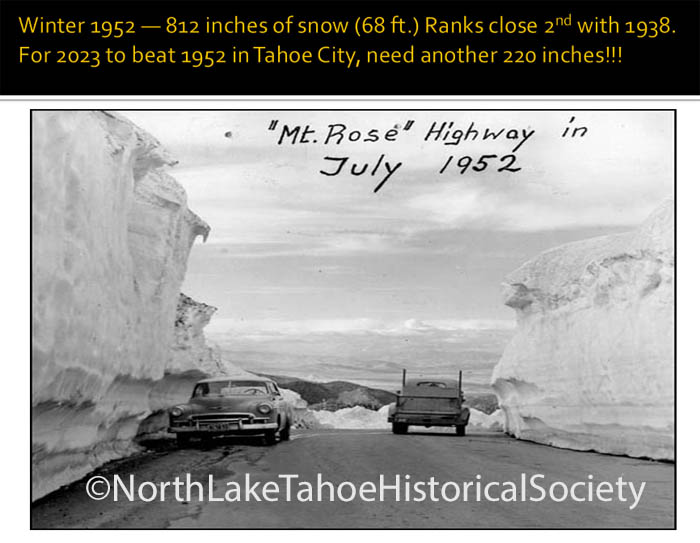
Tahoe City’s 316 inches (26.3 ft.) of snowfall in 2023 was good enough for 5th place, but needs another 220 inches ((18.3 ft.) to overtake the 1st place winter of 1952! Check out the July 1952 snowpack below.

I’ve used this slide for years. General Mariano Vallejo was an important Californio and ally of the United States in the Mexican American War (1846-48). Despite the fact that the Americans arrested and confined him to prison for no good reason. Vallejo is not talking about climate change in the modern sense, he’s commending the Americans for their industry and can-do spirit.

Follow Mark McLaughlin on Facebook

Read my bi-weekly column in Tahoe Weekly magazine.

Categories
Tahoe Ski History Tahoe Snowstorms

TAHOE NUGGET #281: WINTER STORMS & SHOOTING STARS

A powerful cold front is forecast to come barreling through overnight tonight dumping up to 10+ inches of fresh light powder on the upper elevations of the Tahoe Sierra. It’s been a dry December with blocking high pressure entrenched over the eastern Pacific Ocean so the new snow is welcome. (UPDATED 12-20-17. Most resorts received only 3-4 inches of snow.)

Despite the dearth of significant storms so far, Squaw Valley's upper mountain looks pretty good this week. Snow making and grooming crews are also working magic to keep the skiing fresh and are progressively opening new runs and terrain.

In March 1969 Squaw Valley hosted the World Cup races in extremely challenging conditions. Racers had arrived early from all over the world to train on the mountain for the event, but high winds and unrelenting snowfall at the end of February kept everyone cooped up in their hotel rooms. Note snow shovelers on roof.

During the 1969 World Cup preliminary races, athletes endured fierce blizzard conditions. The world’s best skiers could barely see the slalom gates ahead, and deeply carved ruts in the soft snow made the course much more challenging than the icy hard pack downhill racers are used to. Renowned skier, climber, and author Dick Dorworth, who grew up in Glenbrook, Nevada, and raced for the Reno Ski Club, was Chief of Course for the Squaw event. He deployed more than 200 people to boot-pack the runs, but despite their best efforts the volunteers couldn’t keep up with all the new powder and they were forced to cancel the downhill ski event.

Despite the severe conditions, Chief of Race Fraser West, supported by a fleet of snow grooming machines and boot-packing crews, managed to prepare the men’s slalom and giant slalom courses on the steep slopes of KT-22. Luckily for West and everyone else involved in the 1969 effort to host a successful World Cup, the skies cleared on the last day of competition and the racers finally got a chance to see the famed KT-22 terrain they were skiing. Note KT-22 in upper background.

The American contingent at Squaw Valley in 1969 included Tahoe racers like Cheryl Bechdolt, Caryn West, and Lance and Eric Poulsen. Legendary American skiers were there; characters like Billy Kidd (bib #15) and Vladimir “Spider” Sabich. After that season Kidd and Sabich would turn professional and join the newly-formed pro skiing circuit. The dynamic duo with movie star looks helped popularize skiing in the United States in the late 1960s and early 1970s.

Billy Kidd, who won the slalom at Squaw Valley, went on to enjoy a stellar career and is still one of America’s most recognized skiers. Among his many accomplishments, Kidd was the first American male to win a gold medal in alpine skiing and was the first American male to win an Olympic medal (silver-1964) of any kind in alpine skiing. He was also the first American to win a World Alpine Championship combined gold, the first American male to medal in a World Championship slalom, and the only racer to win both amateur and pro world titles in the same season.

Today, Stetson-wearing Billy Kidd is the official promoter for the resort of Steamboat in Colorado.

Spider Sabich was the suspected inspiration (along with Kidd) for the 1969 film Downhill Racer, starring actors Robert Redford, Gene Hackman and Camilla Sparv.

Vladimir Sabich Jr. was a Tahoe skier, raised at Kyburz, a small hamlet west of Echo Pass on Highway 50. Spider grew up ski racing at Mammoth Mountain and Lake Tahoe and later became a two-time world professional champion and Olympic skier. It was amazing that Sabich raced at all at Squaw Valley in 1969 considering that the 23-year-old speedster had already sustained seven broken legs and nine operations during the short span he was a U.S. Ski Team member. He went on to win World Cup races and a national title in downhill. After turning professional in 1971, the next year he won the World Pro Ski title. Tragically it wouldn’t be leg fractures that ended the charismatic racer’s impressive skiing career.

Spider Sabich’s racing credentials and handsome features earned him lucrative product endorsements – soon he was making more than $100,000 a year. He built a ski chalet at Aspen and purchased an airplane that he piloted to skiing events in North America. In 1972 Sabich met French actress and singer Claudine Longet at a pro-celebrity event at Bear Valley, Calif. At the time, Longet was separated from her husband, famed American crooner Andy Williams. Sabich and Longet lived in Aspen together until March 21, 1976, when she shot him to death after Sabich returned from a day of skiing.

Longet claimed that the gun accidently discharged as Sabich was showing her how it worked. Prosecutors pointed out that an autopsy report indicated that Sabich was bent over and facing away at a six foot distance when he was shot, not likely if he was indeed showing her the gun. Police made several procedural errors, however, and a jury convicted her of only criminally negligent homicide. Claudine Longet was sentenced to 30 days in jail and remanded to pay a small fine. Skiing sensation Spider Sabich was dead at age 31.

CLICK HERE<< TO PURCHASE SNOWBOUND! AN ILLUSTRATED HISTORY OF THE TOP 10 BIGGEST WINTERS IN THE TAHOE SIERRA.

CLICK HERE<< TO SIGN UP FOR YOUR FREE TAHOE NUGGETS.

CLICK HERE << TO VIEW MOST RECENT NUGGETS.

CLICK HERE<< TO READ MARK’S TAHOE STORIES & ARTICLES.

VISIT THESTORMKING.COM FOR ARCHIVED NUGGETS & MUCH MORE!

***TAHOE NUGGET PHOTOS ARE AVAILABLE AS PRINTS FOR FRAMING.

Categories
Tahoe Snowstorms

#280: WINTER 2018: TAHOE'S FIRST MAJOR STORM!

Several relatively weak weather systems have brought light precipitation and upper elevation snow to the Tahoe Sierra this November, but the first major storm of the 2018 winter season barreled in last week. Moisture from a moderate to strong Atmospheric River drenched the lower elevations of the Lake Tahoe watershed with up to 10 inches of precipitation, enough to pump up Big Blue’s water level by 4 inches in less than 48 hours. Although it was mostly rain at lake level (6,225'), elevations above 8,000 feet were hammered with up to 40 inches of snow, which enabled several ski resorts to open with limited terrain in time for the Thanksgiving holiday. 

October 25, 2017. Patches of snow from the previous winter remain on Mt. Tallac (9,735'). Last week's storm dumped more than 2 feet of snow on the upper portions of the mountain, guaranteeing that the old snow will roll into winter 2018. "Tallac" is a Washoe Indian word meaning Great Mountain.

Before the recent storm the Tahoe Sierra and nearly all of California were drier than normal. These data represent measurements from the SNOTEL system, which tallies the snow water equivalent in mountain snowpacks. The moisture pattern also reflects the current Climate Prediction Center forecast for the upcoming winter. The long-range prediction is partially based on La Niña conditions that are expected to develop. La Niña-influenced winters are generally wetter than normal in the Pacific Northwest and Rocky Mountains, with drier than average conditions for the Southwest and across the southern states. The Tahoe Sierra averages 94% to 108% of normal precipitation during weak La Niña episodes, just about average.

The Atmospheric River unloaded so much rain, Lake Tahoe's water level rose about 4 inches in less than 48 hours. That's the equivalent of 14 billion gallons. The lake's current elevation of 6,228.16' above mean sea level is within spitting distance of Big Blue's maximum legal limit of 6,229.1'. Another couple of strong ARs could raise the lake past that legal limit. To create more storage, water officials have jacked up the discharge rate through the Tahoe Dam from 70 cubic feet per second to 875 cfs. 

Typical with strong Atmospheric Rivers, high winds preceded its arrival.

Substantial snowpacks are mostly confined to elevations above 7,500 feet, but it's a big improvement over the anemic conditions before the storm.

The Mount Rose Meadows area at around 8,800' picked up a solid 3 feet of wet snow with a 5-inch dusting of powder on top for added bonus. The high elevation means snow when it rains at the lake. The meadows are very popular with Reno and North Tahoe families for sledding, snowmobiling, x-c skiing and snowshoeing. Snowshoeing is the fastest growing winter sport for women.

This snow-covered tree reminded me of a dog sniffing the ground.

On the way back from cross-country skiing at the Mt. Rose Meadows yesterday, I stopped at the overlook on the Mt. Rose Highway to admire the view. The spits of land protruding into the water are ancient lava flows that formed when the northern rim of the Tahoe basin was sealed off by volcanic activity ~3 million years ago. The lake rose 800 feet higher than it is today until water finally breached the rock and erosion lowered it to the current controlled level of 6,225'. 

HAPPY THANKSGIVING EVERYONE!

* Here's a link to my Tahoe Weekly magazine article about Sarah Hale, the woman who worked for 40 years to establish the Thanksgiving Holiday: https://thetahoeweekly.com/2017/11/grateful-thanksgiving-day/

CLICK HERE<< TO PURCHASE SNOWBOUND! AN ILLUSTRATED HISTORY OF THE TOP 10 BIGGEST WINTERS IN THE TAHOE SIERRA.

CLICK HERE<< TO SIGN UP FOR YOUR FREE TAHOE NUGGETS.

CLICK HERE << TO VIEW MOST RECENT NUGGETS.

CLICK HERE<< TO READ MARK’S TAHOE STORIES & ARTICLES.

VISIT THESTORMKING.COM FOR ARCHIVED NUGGETS & MUCH MORE!

***TAHOE NUGGET PHOTOS ARE AVAILABLE AS PRINTS FOR FRAMING.

Categories
Tahoe Snowstorms

#277: NORTHERN SIERRA BREAKS RECORD!

Ongoing Pacific storms this April have continued to impact the Tahoe Sierra with more rain and snow. The snowpack is melting fast at the lower elevations, but the bulk of snow and its water equivalent is above the 7,000 foot elevation. Cool temperatures with cloud cover has slowed the traditional Spring melt. 

Statistically, the Sierra snowpack reaches it maximum water density around the first week of April, but this year a wet Spring continues to add to the record amount of water in the mountains. 

Due to its high base elevation of 8,260' above sea level, the Mt. Rose ski area has pulled in more than 63 feet of snow so far this winter – a new record for the resort. Currently, the snow is 19 feet deep on the slopes and ski conditions are excellent.